Inherited a Box of Morgan Dollars? Start Here
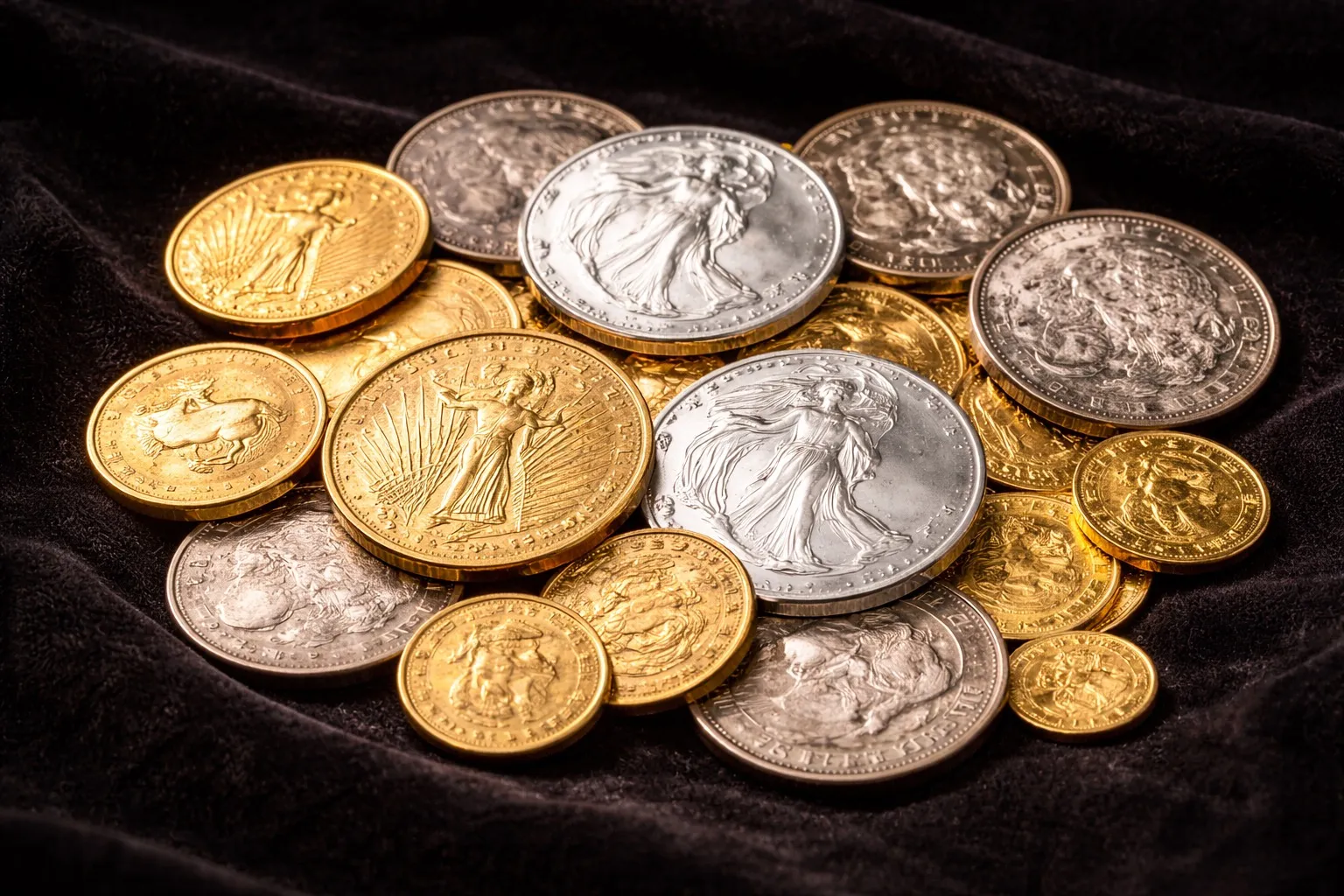
Most people who ask what is a Morgan dollar worth are not collectors at all. They are standing over a shoebox, a coffee can, or a velvet-lined dresser drawer that came down from a parent or grandparent, full of big heavy silver dollars nobody ever sorted. That is exactly the situation the Farmingdale shop sees most often, and it is good news, because an inherited Morgan hoard is one of the more rewarding piles to go through. Struck from 1878 to 1904 and again in 1921, the Morgan silver dollar is large, mostly ninety percent silver, and almost always worth real money, even the common ones.
Here is the honest framing before you bring it in. Every genuine Morgan dollar has a silver melt floor, a baseline value that tracks the live silver spot price and rises or falls with the metal market no matter the date. That floor is the worst your coin does. On top of that floor, certain dates, mintmarks, and grades carry a collector premium that can lift a single coin far above its silver weight. The whole job of a good appraisal is separating the coins that are worth their silver from the few that are worth much more, and you cannot do that from a photo or a website estimate. It takes the actual coins on a counter.
Cash 4 Gold Trading Post is a licensed and insured New Jersey precious metals dealer at 68 Main Street, Unit 3 in Farmingdale Borough. When you set an inherited box of Morgans on the counter, we go through it coin by coin, in front of you, and tell you which ones are melt and which ones are not. There is no obligation to sell anything.
Wondering which store is closest? See the store nearest Farmingdale and the towns it serves and sell gold in Farmingdale, NJ.
The Silver Melt Floor and the Key Dates Above It
A Morgan silver dollar weighs 26.73 grams and is ninety percent silver, which puts roughly three-quarters of an ounce of actual silver in every coin. That silver content sets the Morgan silver dollar value floor: whatever the date, a worn, common Morgan is worth its silver, calculated against the live spot price on the day you come in. Common-date Morgans in circulated shape, the 1921, and the heavily traded Philadelphia and New Orleans years usually trade close to that silver number, and that alone is a solid value for a big bag of them.
Then there are the coins that break away from the floor. Carson City Morgans, the ones carrying the CC mintmark from the famous Nevada mint, are scarce and sought after across almost every date, and a CC coin is the first thing a careful appraiser looks for. A handful of dates are genuinely rare, the 1893-S being the most famous key of the whole series, with the 1889-CC and a short list of others close behind. Grade matters enormously too. A coin that has been sitting untouched in original mint luster can be worth a large multiple of a worn example of the very same date and mintmark. This is why pouring an inherited box straight into a melt pile is the costliest mistake you can make.
Don't Clean Them First
The single most common way owners accidentally cut their own offer is cleaning the coins before bringing them in. A Morgan dollar that looks dull or toned is doing exactly what a hundred-year-old silver coin should do, and that original surface is part of what a collector pays a premium for. Scrubbing, polishing, or dipping a coin in jewelry cleaner strips that surface and leaves hairline scratches that knock a potential key-date premium right back down toward melt. If your inherited coins look dusty or tarnished, leave them alone. Bring them as they came to you, original quirks and all, and let the appraisal account for true condition.
Bring it in and watch it valued at the counter. Free, no obligation, same-day cash.
Call the Farmingdale store on (732) 489-1314How the Free In-Person Appraisal Works
Each Morgan is read as a coin first. We check the date, the mintmark below the eagle on the reverse, the strike, and the surface to flag any CC coins, any key or semi-key dates, and any pieces whose grade lifts them well above melt. Those coins are set aside and valued on what they command in the current collector market, not on weight. It is the same care a serious buyer would give an inherited collection, done in front of you so you can see why one coin in the box is treated differently from the fifty around it.
The remaining coins, the common-date silver, are valued on their metal. The silver is verified with a professional XRF analyzer that reads exact metal content through X-ray fluorescence, with no acid and no damage to the coins, and weighed on an NTEP-certified, New Jersey state-approved scale turned toward you. That figure is calculated against the live silver spot price, and the key-date premiums are added on top. Your free, no-obligation appraisal is laid out coin by coin so you can see exactly how the total was reached. If a search for sell Morgan dollar brought you here and the number works, payment is a same-day cash offer on the spot. If it does not, every coin goes right back in the box with no fee for the look.
Bringing an Inherited Collection to 68 Main Street
Estate coins almost never live in the same town as the shop that appraises them, and Farmingdale Borough is an easy and unhurried place to bring them. The borough sits in a quieter inland pocket of western Monmouth County off Route 33 and Route 524, with a real downtown instead of a highway strip. You park right on Main Street and carry a heavy box of silver dollars a few steps to the door at Unit 3, rather than hauling it across a six-lane lot. From Howell and Wall Township you are usually here in well under fifteen minutes, and Freehold, Colts Neck, Belmar, and Manasquan are all an easy drive in.
These shore and inland horse-country towns hold a lot of inherited silver that has sat untouched for decades: a roll of Morgans a grandfather set aside, a Carson City coin tucked in with the common ones, a tin of dollars cleaned out of an estate that nobody has ever had read by a professional. As one of eight Cash 4 Gold Trading Post stores across Central New Jersey, the Farmingdale shop carries the same 5-star Google reputation as the rest of the family while staying small enough that you deal with someone who will actually sort your box coin by coin and talk you through what is melt and what is not. Walk in Monday through Friday from 10 AM to 6 PM, plus Saturday, or check hours and directions on the Farmingdale location page.
How does selling outright compare with a pawn loan or a mail-in offer?
People who search for a pawn shop are usually not asking for a loan. They are asking for cash today, and pawning is simply the route they know. It is worth seeing the routes side by side, because they differ on the one question that matters most: when you walk out, is the item still hanging over you?
A pawn loan gives you money and keeps your item as collateral. Interest accrues, a repayment date is set, and if that date passes the item is gone. Selling outright ends the transaction at the counter. You are paid, the item is ours, and there is no balance, no clock and nothing to come back for. That is the whole reason a seller who never wanted a loan is usually better served by a buyer.
| How you turn it into cash | How long it takes | Who inspects it, and where | Do you keep your item | What you owe afterwards |
|---|---|---|---|---|
| Sell outright at our Farmingdale counter | About fifteen minutes, paid the same day | You do, watching, at a counter it never leaves | You choose: accept and it is sold, decline and it goes home with you | Nothing. There is no loan and no interest |
| Take a pawn loan against it | Same day for the cash | Staff, often out of your line of sight | The shop holds it as collateral until you repay | The loan plus interest, by a deadline, or you forfeit the item |
| Mail it away to a buying service | One to three weeks round trip | Someone you will never meet, after it has left your hands | No. It is gone before anyone quotes you a number | Nothing, but you have no leverage left to negotiate with |
| Use an online instant-quote tool | Minutes for an estimate, then it becomes a mail-in | Software estimates, a person checks it later and off-site | No, once you have posted it | Nothing, but the on-screen figure was never a binding offer |
| Sell privately to a stranger | Unpredictable, sometimes weeks | Nobody with testing equipment | Until money changes hands | Nothing, but the safety and payment risk are yours alone |
None of this makes a pawn loan wrong. If you want your item back and only need money for a few weeks, a loan is the right instrument: a licensed pawnbroker holds the piece as collateral until you repay the loan with interest by the due date. Lending is not something we do, so go to a licensed pawnbroker for it. If you are done with the piece, we buy outright and pay for the item itself, so there is no loan, no interest and no risk of losing it.
What happens when you walk into the Farmingdale store?
There is no appointment, no back office and no waiting room. You walk in, what you brought is examined in front of you, and you leave with either cash or your own items, unchanged. Most visits are done inside fifteen minutes. Here is the whole sequence, so nothing about it is a surprise.
| Step | What happens | About how long | What you can do |
|---|---|---|---|
| 1. Walk in | No appointment. Bring a government-issued photo ID, which New Jersey law requires a licensed dealer to record, and whatever you want valued | Straight to the counter | Ask anything before you hand over a single piece |
| 2. Everything is sorted | Each item is identified and grouped, and anything worth more intact than broken down is set aside before any valuing starts | A few minutes | Watch it happen. Nothing goes into a back room |
| 3. It is tested in front of you | Gold, silver and platinum are read on an XRF analyzer and weighed on a New Jersey certified scale with the display facing you. Anything that is not a precious metal, such as a stone, a watch movement or a card balance, is verified on its own terms at the same counter | Two to five minutes | Read the purity and the weight yourself |
| 4. You hear one firm number | The offer is built from what was just measured against that day's live market, and every step of the arithmetic is shown to you | Minutes | Ask how any part of the figure was reached |
| 5. You decide | Accept and you are paid the same day. Decline and your items are handed straight back, exactly as you brought them in | Your call, with no clock running | Walk out and think about it. The appraisal was free either way |
Two details in that sequence are the ones worth insisting on anywhere you sell, not only here. Your items should never leave your sight, and you should be able to read the test result and the scale yourself. A valuation done where you cannot see it is a number you have to take on trust, and there is no reason to.
How is an offer on gold and silver actually calculated?
Every offer on precious metal comes from three numbers and nothing else: how pure the piece is, what it weighs, and what that metal is trading for on the world market at that moment. Design, brand and the price on the original receipt do not enter into it, which is the single most common surprise for a first-time seller. That is also why an honest offer can be checked by anyone with a calculator.
Metal is priced by the troy ounce, which is 31.1035 grams, not the ounce on a kitchen scale. Writing $S for the live spot price of one troy ounce of that metal on the day you sell, the melt value of a piece is:
Worked example. Take a chain that weighs 20 grams and tests at 58.5 percent pure, which is what a 14K stamp means.
- Pure metal content: 20 grams × 0.585 = 11.66 grams.
- Convert to troy ounces: 11.66 ÷ 31.1035 = 0.3749 troy ounces.
- Multiply by the live price: 0.3749 × $S is the melt value at that moment.
Swap the purity decimal and the same formula covers anything you bring. The stamps below are the ones that turn up most often at the counter, and knowing yours before you walk in means you can follow the offer as it is being built rather than simply receiving it.
| Stamp on the piece | Metal | Pure metal content | Where you usually see it |
|---|---|---|---|
| 10K or 417 | Gold | 41.7 percent gold | The legal minimum to be sold as gold in the United States; class rings, budget chains |
| 14K or 585 | Gold | 58.5 percent gold | The most common karat in American jewelry; everyday chains, rings and bracelets |
| 18K or 750 | Gold | 75.0 percent gold | Higher-end, designer and European pieces; deeper colour, more metal |
| 22K or 916 | Gold | 91.7 percent gold | Common in Indian, South Asian and Middle Eastern jewelry; soft and deep yellow |
| 24K, 999 or 999.9 | Gold | 99.9 percent gold | Bullion bars and investment coins; too soft for daily-wear rings |
| Sterling, 925 or STER | Silver | 92.5 percent silver | Flatware, tea services, candlesticks, hollowware and most silver jewelry |
| Coin silver or 900 | Silver | 90 percent silver | United States dimes, quarters and half dollars struck in 1964 and earlier |
| .999 or fine silver | Silver | 99.9 percent silver | Bars, rounds and modern bullion coins |
| PLAT, PT950 or 950 | Platinum | 95 percent platinum | Engagement settings and better watch cases; noticeably heavier than gold looks |
| GP, GF, GEP, RGP or HGE | Base metal | A trace, not solid | Plated or filled: a thin gold layer bonded over brass or steel, with little recoverable metal |
A stamp is a claim, not a guarantee, in either direction. Under-marked and unmarked pieces turn out to be solid more often than people expect, and older or imported jewelry was frequently never stamped at all. That is exactly why the piece gets tested rather than read. Two rules protect you at any counter: karats are never weighed together, because mixing them lets the whole pile be paid at the lowest purity in it, and pieces worth more intact than melted are pulled out before anything else happens.
Where is the Farmingdale store, and when can you walk in?
The Farmingdale store is a walk-in counter at 68 Main St, Unit 3, Farmingdale, New Jersey 07727. There is no appointment system and no queue to join online. Here is everything you need before you set off.
| Detail | Farmingdale store |
|---|---|
| Address | 68 Main St, Unit 3, Farmingdale, NJ 07727 |
| Phone | (732) 489-1314 |
| Hours, Mon-Fri | 10 AM to 6 PM |
| Hours, Sat | 11 AM to 4 PM |
| Hours, Sun | Closed |
| Appointment | Not needed. Walk in any time the doors are open |
| What to bring | A valid government-issued photo ID, required by New Jersey law, plus everything you want valued |
| Cost of an appraisal | Free, with no obligation to sell |
| How you are paid | Same day, on the spot, once you accept the offer |
Prefer to check before you drive over? Call (732) 489-1314 and describe what you have. Full directions, parking notes and the map for this store are on the Farmingdale location page, and the other Central New Jersey counters are listed on the locations page if a different one is closer to you.
Free appraisal, no obligation, and you keep your items if you say no.
Call Farmingdale on (732) 489-1314Common questions about the Farmingdale store
What is a Morgan silver dollar worth?
Every genuine Morgan dollar has a silver melt floor, since each coin is ninety percent silver and worth that metal at the live spot price no matter the date. Common-date and 1921 Morgans usually trade close to that silver value. Above the floor, certain dates, mintmarks, and grades carry a collector premium, with Carson City CC coins and keys like the 1893-S and 1889-CC worth far more than their silver. We read each coin in front of you to separate the two.
Is my 1921 Morgan dollar worth more than melt?
The 1921 is the most common year of the entire series, struck in huge numbers, so a circulated 1921 Morgan typically trades close to its silver value rather than carrying a big collector premium. That is still a real, solid number, and a high-grade 1921 with strong original luster can do better. Bring it in with the rest of your coins and we will read its grade and tell you exactly where it lands.
Is the appraisal free, and can I get paid the same day?
Yes on both. The in-person coin appraisal is completely free and carries no obligation, and once you accept a number, it is a same-day cash offer on the spot at 68 Main Street, Unit 3 in Farmingdale. If the number does not work for you, every coin goes right back in the box with no fee. Call (732) 489-1314 with any questions first or just walk in.
Is the appraisal free, and how soon am I paid?
The appraisal is free and carries no obligation. If you accept the offer you are paid the same day, on the spot at 68 Main St, Unit 3 in Farmingdale. If you decline, your items are handed straight back exactly as you brought them in and you owe nothing either way. Call (732) 489-1314 first if you would rather describe a piece before you drive over.
What do I need to bring to the Farmingdale store?
Bring a valid government-issued photo ID, which New Jersey law requires a licensed dealer to record for every transaction, plus everything you want valued, including pieces you are not sure about. Do not clean or polish anything, because it does not raise the figure and it can damage a piece that was worth more intact. Keep matching sets together. No appointment is needed at 68 Main St, Unit 3, Farmingdale.
Keep reading before you sell
The complete New Jersey selling guide · Cash for gold near me · Frequently asked questions