
Sell Gold Jewelry and Diamond Rings for Cash in New Jersey
Rings, necklaces, bracelets, earrings. Broken or perfect. We pay the highest prices in Central NJ.
Freehold sellers: our Millstone location at 494 Monmouth Road is about 15 minutes via Route 33. Same-day cash, no appointment needed.
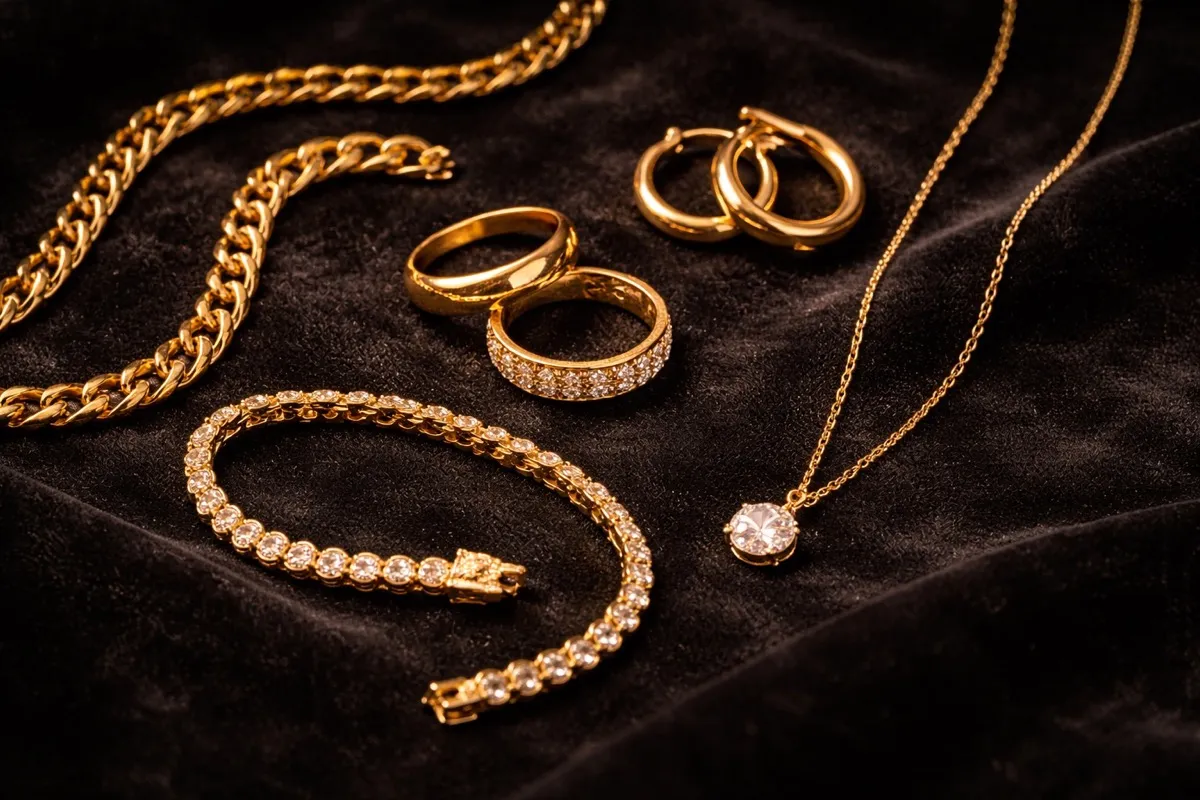
Quick answer: Cash 4 Gold Trading Post buys all gold jewelry, rings, chains, bracelets, earrings, pendants, and dental gold, in 10K, 14K, 18K, 22K, and 24K purities. Every piece is tested on-site with XRF (X-ray fluorescence) technology for a precise karat reading, and you receive an instant cash offer based on current gold spot prices. No appointment needed at any of our 6 Central NJ locations.
Why Sell Your Gold Jewelry to Us?
Highest Payouts Guaranteed
We pay based on current gold spot prices and actual karat weight. Bring a competitor's quote and we'll beat it.
Instant Cash Payment
No waiting for checks. Get cash in hand within minutes of your appraisal. Walk in, walk out paid.
Expert Testing On-Site
Our certified appraisers use professional XRF analyzers and acid testing to accurately determine karat purity.
We Buy Broken & Damaged
Missing stones? Broken clasp? Tangled chains? We buy gold in ANY condition. It all has value.
What Determines the Value of Gold Jewelry?
Three factors drive your payout: karat purity, weight in grams, and the daily gold spot price. Here is how each one works:
How Does Karat Purity Affect What Gold Jewelry Is Worth?
Karat purity is the single biggest factor in your gold jewelry payout. Higher karat means a higher percentage of pure gold in the alloy:
- 24K (99.9% pure gold): The highest purity available. Rare in wearable jewelry because it is too soft. Found in some Chinese and Hong Kong pieces, gold bars, and commemorative items. Pays approximately $62 to $70 per gram at current spot prices.
- 22K (91.7% pure gold): Common in Indian wedding jewelry, Middle Eastern gold, and South Asian bangles. Pays approximately $56 to $64 per gram.
- 18K (75.0% pure gold): Used in fine jewelry, designer pieces from brands like Tiffany and Cartier, and Italian gold chains. Pays approximately $46 to $54 per gram.
- 14K (58.3% pure gold): The most common karat in American jewelry. Found in wedding bands, engagement settings, and everyday necklaces. Roughly 70% of the gold pieces Cash 4 Gold Trading Post buys are 14K. Pays approximately $35 to $42 per gram.
- 10K (41.7% pure gold): The legal minimum to be labeled "gold" in the United States. Found in class rings and affordable fashion jewelry. Pays approximately $25 to $30 per gram.
Cash 4 Gold Trading Post tests every piece with an XRF analyzer to determine exact purity. No guessing, no rounding down.
How Does Weight Affect What Gold Jewelry Pays?
Gold is weighed in grams or troy ounces, and every fraction of a gram counts. A typical men's 14K wedding band weighs 5 to 8 grams and pays $175 to $335 at current spot prices. Even small, delicate pieces add up. That drawer full of old chains and single earrings could easily total 20 to 40 grams, worth $400 to $1,600 depending on karat.
What Types of Gold Jewelry Does Cash 4 Gold Trading Post Accept?
- Gold rings: Wedding bands (2 to 12 grams typical), class rings (8 to 15 grams typical), cocktail rings, signet rings, and stackable bands in any karat from 10K to 24K.
- Necklaces and chains: Rope chains, figaro chains, Cuban links, herringbone, box chains, and pendants. Any length, any style, any karat. A heavy 14K Cuban link chain can weigh 30 to 80 grams and pay $600 to $2,000+.
- Bracelets and bangles: Tennis bracelets, charm bracelets, cuff bangles, and link bracelets. Indian 22K bangles are especially valuable due to high gold content.
- Earrings: Hoops, studs, drop earrings, and singles. You do not need a matching pair. A single gold earring pays based on its weight and karat.
- Pendants and charms: Religious medals, initials, lockets, and decorative charms. Even small charms weighing 1 to 2 grams have value.
- Broken, tangled, or damaged pieces: Snapped chains, crushed rings, bent bangles, and tangled knots of gold. Condition does not affect melt value.
- Gold dental work: Crowns, bridges, and grills. Dental gold is typically 10K to 20K solid gold and often pays $50 to $200+ per piece depending on size and karat.
- Gold watches and watch bands: Solid gold watch cases, gold watch bands, and gold watch bezels. We separate gold components from non-gold parts before weighing.
What Four Factors Determine Your Gold Jewelry Payout?
Four things drive what you walk out with. Here's exactly how we calculate it:
Karat Purity
This is the biggest factor. A 24K chain pays nearly twice what a 10K chain of the same weight pays. We test every piece with no guessing and no rounding down.
Weight in Grams
More gold = more money, period. Chunky chains, wide bangles, and heavy men's rings pay significantly more than delicate pieces. Every gram counts.
Current Spot Price
Gold prices change daily. We use the live market price at the time of your visit, so when gold is up, your payout goes up with it. Check today's price above.
Condition? Doesn't Matter
Broken, bent, missing stones, tarnished: none of it affects melt value. We buy gold for its metal content, not its looks. Your mangled chain pays the same as a pristine one.
Quick math example: A 14K gold necklace weighing 10 grams contains about 5.83g of pure gold. At $65/gram spot, that's roughly $310 in pure gold value. We pay a strong percentage of that, typically well above what pawn shops or mall kiosks offer.
How We Evaluate Your Gold Jewelry: Step by Step
No mysteries, no black boxes. Here's exactly what happens from the moment you walk through the door:
You Walk In. No Appointment Needed.
Walk into any of our six New Jersey locations during business hours. There's no line system and no appointment book. You go straight to the counter.
If we're helping someone else, the wait is rarely more than five minutes. Bring your gold in a bag, a box, a sock. It doesn't matter. The whole process from door to cash typically takes 10 to 20 minutes, depending on how many pieces you have.
Quick ID Check (Required by NJ Law)
New Jersey's precious metals purchase statute (N.J.S.A. 2C:21-36 et seq.) requires us to record your name, address, and a valid government-issued photo ID for every transaction. This is standard across all licensed precious metals dealers in the state. It's not about us being nosy.
We photocopy your driver's license or passport, log the transaction, and that's it. The whole step takes about 60 seconds. We hold transaction records for the legally required period and keep your information confidential.
Sorting and Purity Testing: XRF Analyzer and Acid Test
Our appraiser spreads your pieces on a padded tray and sorts them by visual inspection, looking at karat stamps (10K, 14K, 18K, etc.), color, and construction. Then we test. Our primary tool is a professional XRF analyzer, which uses X-ray fluorescence to read the exact metal composition of each piece in about 15 seconds without damaging it.
The XRF gives us a precise percentage breakdown: gold, silver, copper, zinc, nickel, and everything else in the alloy. For pieces where the XRF reading is ambiguous, we use acid testing as a secondary confirmation. Acid testing involves rubbing the piece on a touchstone and applying nitric acid solutions of known concentration to see which dissolves the mark.
If the mark survives 14K acid but dissolves with 18K acid, the piece is 14K. Between the two methods, we can determine karat purity on virtually any piece, even antique jewelry with no stamp.
Weighing on NTEP-Certified Scales
Once pieces are sorted by karat, each group goes on our NTEP-certified digital scale. NTEP (National Type Evaluation Program) certification means the scale meets federal accuracy standards for commercial trade, the same standard used at delis, pharmacies, and post offices. It's calibrated regularly and accurate to 0.01 grams.
We weigh each karat group separately because 10K gold and 18K gold have very different per-gram values. The scale faces you in real time. We write down each weight in front of you and nothing happens behind a curtain.
Spot-Price Calculation and Cash Offer
Here's the math, and we'll walk you through it at the counter. For each karat group: weight in grams × karat purity percentage × current gold spot price per gram = pure gold value. For example, 15 grams of 14K gold at $65/gram spot: 15g × 0.583 × $65 = $568.43 in pure gold value.
We then offer a percentage of that melt value. Our margin covers refining costs, overhead, and business expenses. We add up all your karat groups and give you one total offer with no pressure to accept.
If you accept, we count out cash on the spot. No checks, no "we'll mail it," no 3-to-5 business days. Cash in your hand before you walk out the door.
Total time: 10–20 minutes for most visits. If you have a large collection (50+ pieces), it may take 30–45 minutes because every single piece gets individually tested and sorted. We don't rush the process and we don't skip steps.
What Happens When You Bring Gold Jewelry to Cash 4 Gold Trading Post?
Here's what to expect when you walk in with your gold jewelry:
Cleaning Out a Loved One's Jewelry Box
This is one of the most common things we see. You've inherited a collection: some pieces are clearly nice, others look like costume jewelry, and half of it is tangled in a bag. Bring all of it. We'll sort through everything with you right at the counter.
Here's what the sorting process actually looks like: our appraiser lays everything out on a padded tray and creates three piles. Pile one is pieces with visible karat stamps (10K, 14K, 18K) that go straight to XRF testing for confirmation. Pile two is unmarked metal pieces that could be gold, which get acid tested to determine if they're solid gold, gold-filled, or base metal. Pile three is clearly costume jewelry: plastic beads, magnetic clasps, brass findings with green tarnish. We'll show you how to spot costume pieces yourself. A magnet test is a quick first filter, since real gold isn't magnetic.
There's no charge for pieces we can't buy, and we'll tell you exactly what you have and why. Families often walk out with $400–$1,500 from a drawer of "old jewelry" that's been sitting untouched for years. One family from East Brunswick brought in a shoebox in 2024. What they thought was mostly costume turned out to include three 18K Italian chains worth over $800 combined.
The Junk Drawer Full of Single Earrings and Broken Chains
You probably have one. Everyone does. That pile of broken necklaces, solo earrings without a match, a bent ring, a clasp that snapped off. It looks like garbage, but it's not. Gold doesn't care that a chain is in three pieces.
Here's a real weight breakdown from a typical junk-drawer visit: two broken 14K chain segments (6.2g combined), one single 10K hoop earring (1.8g), a bent 14K ring missing its stone (3.1g), and a 14K charm bracelet with a snapped clasp (9.4g). The 14K pieces total 18.7 grams. At $65/gram spot, that's 18.7 × 0.583 × $65 = $708 in pure gold value. The 10K earring adds 1.8 × 0.417 × $65 = $48.80. Grand total melt value: roughly $757. The customer walked in thinking the bag was worth maybe $50. They left with several hundred dollars in cash.
The lesson: don't sort through it yourself trying to decide what's "worth bringing in." Bring the whole bag. Testing is free, and the small pieces add up fast. A single 14K earring post weighs about 0.5 grams, which is still a few dollars of gold. Ten of those and you've found money you didn't know you had.
Selling a Wedding Band You're Never Going to Wear Again
Divorce, remarriage, or just moving on. We see wedding bands come in all the time and there's zero judgment here. Nobody at our counter is going to ask why you're selling. It's a business transaction, nothing more.
Here's what the numbers look like. Women's wedding bands are typically thinner. A standard 14K women's band runs 2 to 4 grams, paying roughly $75–$150 depending on spot price. Men's bands are significantly heavier: a classic 6mm 14K men's band weighs 5 to 8 grams, and a wider 8mm comfort-fit band can hit 9 to 12 grams. At current prices, a heavy men's 14K band can pay $200–$450+.
White gold vs. yellow gold is a question we get a lot. The answer: they pay the same per gram at the same karat. White gold is just yellow gold alloyed with palladium or nickel instead of copper. It's the same gold percentage. A 14K white gold ring is 58.3% pure gold, identical to a 14K yellow gold ring. The rhodium plating on white gold is too thin to add value, but the gold content underneath is identical. So don't assume your white gold band is worth less. It's not.
Sell a Diamond Ring for Cash: What Actually Happens
Diamond rings are one of the most misunderstood items people bring in to sell. Here is the honest breakdown:
The Gold Setting Has Solid Melt Value
Every diamond ring sits in a gold setting, and that gold pays regardless of the diamond. A platinum diamond ring with a 14K gold prong structure still has that gold weighed and paid separately. Most engagement ring settings run 3 to 8 grams of gold, depending on the style. At current spot prices, a 14K setting at 5 grams is worth roughly $275 to $325 in gold value alone.
Bring your ring in, and we will separate the value components clearly. The gold setting gets weighed and priced at the live spot rate. The diamond evaluation is separate.
What We Pay for Diamonds
Diamonds are assessed on the 4 Cs: cut, color, clarity, and carat weight. Retail diamond prices include significant markup for brand, presentation, and retail overhead. Resale values for diamonds are typically 20 to 50 percent of retail depending on quality and market demand. We give honest assessments based on current wholesale diamond values.
Round brilliant cuts in 1 carat plus sizes with VS clarity and G-H color hold value better than other shapes and grades. Princess cuts, cushion cuts, and fancy shapes trade at lower premiums in the resale market. An I1 clarity stone in a lower color grade has limited resale value. We will tell you exactly what the diamond is worth on today's market, without pretending the retail price you paid has anything to do with what a buyer will pay today.
The Process When You Sell a Diamond Ring
Walk in during business hours. You do not need an appointment. Our appraiser examines the ring and gives you two numbers: what the gold setting is worth at melt value, and what the diamond would bring on today's market. You can sell both together or either component separately. Some people sell just the gold and keep the stone. Some sell both for a clean single transaction. The choice is yours.
We test the gold with our XRF analyzer for exact karat confirmation. The diamond gets examined under magnification for cut grade, visible inclusions, and color. If you have a GIA certificate for the diamond, bring it. Certified stones are easier to price accurately and typically command better offers. No certificate? We still appraise. It just takes a few extra minutes.
What Affects the Diamond Value More Than Anything
Carat weight is the biggest driver by far. A 2-carat round G/VS1 is worth multiples of a 0.5-carat in the same grade. Size matters more than perfection. A slightly included 1.5-carat diamond is worth more than a flawless 0.3-carat. If you know your stone is under half a carat, set realistic expectations: small diamonds under 0.5 carats have limited resale value because the market for them is thin. A 0.25-carat diamond in an otherwise standard ring mostly returns value from the gold setting.
For rings with larger center stones, or rings from known designers like Tiffany, Cartier, or Harry Winston, we factor in the brand premium. A Tiffany solitaire setting has collector value beyond just the gold and diamond weights.
Want to know what your ring is worth before you drive out? Call any of our six locations and describe what you have. We can give you a rough range over the phone based on the details you provide.
Gold Jewelry Questions Answered
Straight answers to what people actually ask us before coming in:
How do you test whether my jewelry is real gold?
We use two methods: acid testing and XRF (X-ray fluorescence) analysis. Acid testing applies a small solution to a scratch from your piece and checks the reaction. XRF is non-destructive. We hold a device up to the jewelry and it reads the metal composition in seconds. Between the two, we can confirm karat with high accuracy on nearly any piece, even if the stamp has worn off.
Does broken jewelry still pay well?
Yes, 100%. A snapped chain, a ring that got crushed, a pendant that's been through the dryer. The gold content doesn't change because the piece is damaged. We melt gold down for its metal value, so condition is genuinely irrelevant to your payout. Bring your broken pieces. They're worth more than you think.
Do you buy gold teeth and dental gold?
We do. Dental gold is typically 10K to 20K, and it's solid gold, not plated. Gold crowns, bridges, and grills all have real metal value. Dental gold often pays well because of its high purity. Clean it up a bit before you come in (thoroughly, please), and we'll weigh and test it the same as any other piece.
What's the difference between gold-plated and solid gold?
Big difference. Gold-plated jewelry has a base metal (usually brass or copper) with a thin layer of gold on the outside, typically a few microns thick. That's not enough gold to have meaningful melt value. Solid gold (stamped 10K, 14K, 18K, etc.) is gold all the way through. Gold-filled is in between, thicker than plating but not solid. We'll test your pieces and tell you exactly what you have. No guessing required.
My jewelry doesn't have a karat stamp. Can you still buy it?
Yes. Stamps wear off, old pieces weren't always marked, and some foreign gold doesn't follow US stamping conventions. That's exactly what our testing equipment is for. We'll determine the purity through acid testing or XRF and pay you based on verified content, not a guess or a worse-case assumption.
Can I sell just one earring from a pair?
Absolutely. We don't require pairs. A single gold earring pays based on its weight and karat, just like any other piece. You're not penalized for having the solo. Bring the one you have and get paid for it.
Should I sell gold when the price is high?
It depends on your situation, but here's the honest answer: trying to perfectly time the gold market is a losing game, even for professional traders. Gold prices are driven by global factors including Federal Reserve interest rate decisions, inflation data, geopolitical instability, and central bank buying, and nobody can reliably predict short-term swings. That said, there's a practical approach. Check the gold spot price chart before you come in (we display the live price on our website). If gold is near a 52-week high, you're selling into strength and that's generally a good time. If it's near a low, you might want to wait a few weeks and see if it recovers. Unless you need the cash now, in which case selling today beats leaving gold in a drawer indefinitely. The real risk isn't selling at the "wrong" time. It's never selling at all and letting jewelry sit unused for another decade. Gold you're not wearing isn't earning you anything.
How Much Is Each Karat of Gold Worth per Gram?
Use this chart to estimate what your gold jewelry might be worth before you visit. Values are approximate ranges based on typical market conditions.
*Per-gram values are estimates based on a gold spot price of approximately $60–$70/gram and represent melt value before dealer margin. Actual payouts vary with daily spot prices. Check the live ticker at the top of this page for today's gold price. Last updated March 2026.
How to read karat stamps: Look on the inside of rings, on necklace clasps, or on earring posts for tiny engravings like "14K," "585" (14K in European millesimal notation), "750" (18K), or "916" (22K). If you can't find a stamp or it's worn away, don't worry. We'll test the piece and determine its purity for free.
Sell Gold Jewelry at Any of Our 6 New Jersey Locations
Walk in to any Cash 4 Gold Trading Post location for a free gold jewelry appraisal. No appointment needed. See our complete New Jersey gold selling guide →
All locations offer free gold jewelry appraisals with instant cash payment. Open 6 days a week, no appointment required. Whether you're in East Brunswick, Middlesex, Millstone, New Brunswick, Brick, or Manalapan, there's a Cash 4 Gold Trading Post near you ready to buy your gold jewelry today.
💰 Get Your Gold Jewelry Quote
Free appraisal, no obligation. We respond within minutes.